How the Meshtastic Signal Meter Works
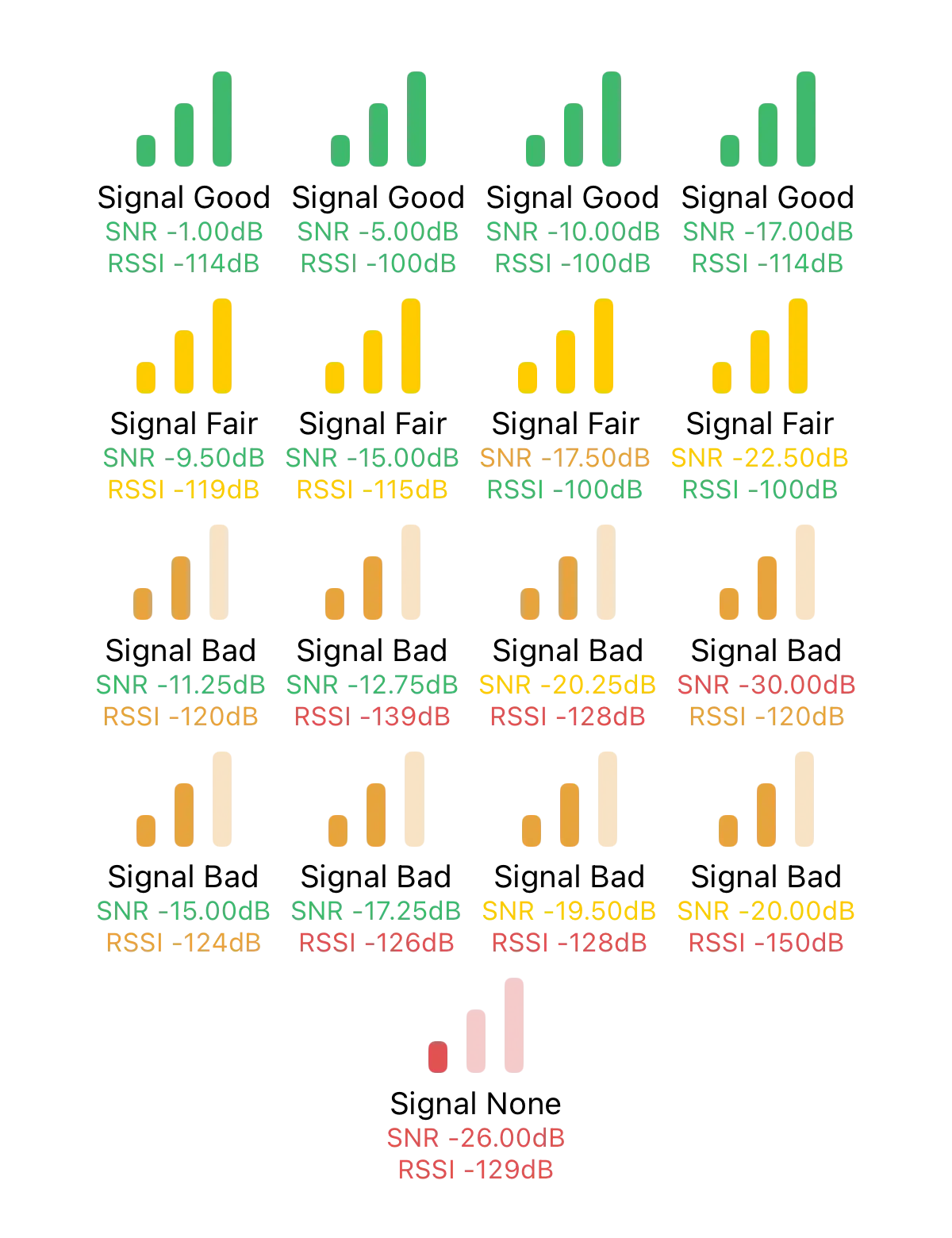
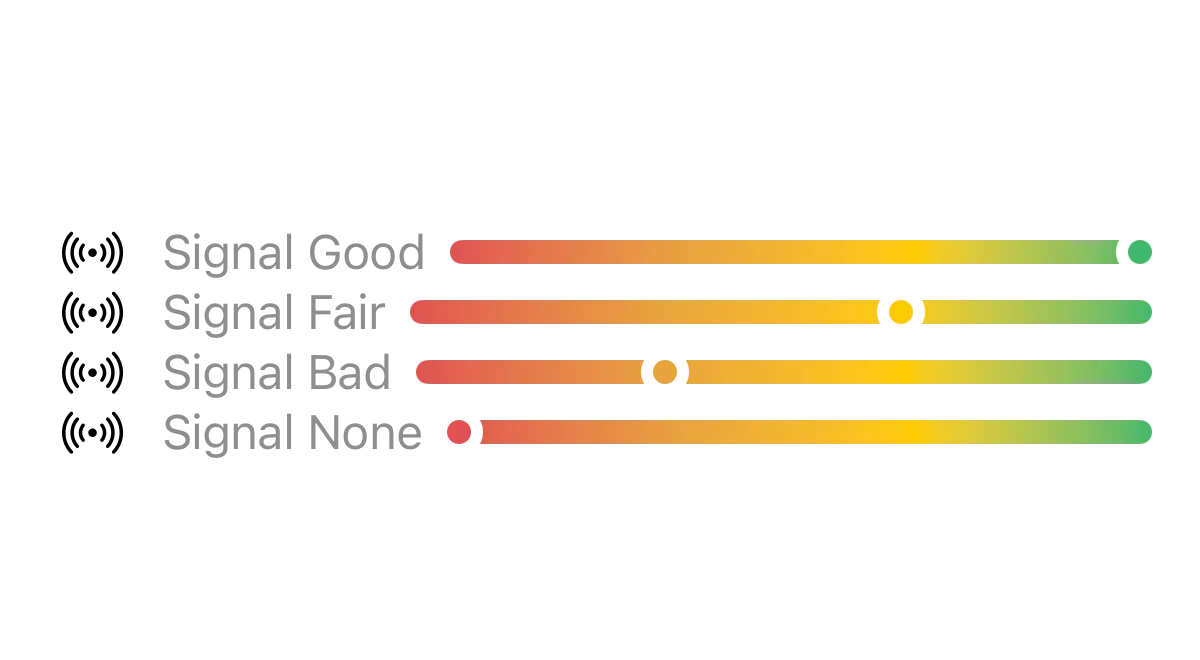
The Meshtastic signal meter—often seen as a series of bars or a status color in the app—is calculated very differently than the "bars" on a traditional cell phone or Wi-Fi router.
Most consumer devices just measure how "loud" a signal is. However, because Meshtastic uses LoRaLoRaA low-power, long-range wireless communication technology used by Meshtastic devices to enable communication over distances of several kilometers without the need for cellular, Wi-Fi, or other traditional network infrastructures. (Long Range) technology, its signal meter uses logic that measures how clear the signal is, relative to the specific settings your mesh is using.
1. The Two Metrics: "Loudness" vs. "Clarity"
To understand the meter, you need to understand the two measurements the LoRaLoRaA low-power, long-range wireless communication technology used by Meshtastic devices to enable communication over distances of several kilometers without the need for cellular, Wi-Fi, or other traditional network infrastructures. radio chip takesTAK (Team Awareness Kit). A situational awareness ecosystem. Meshtastic bridges to it by converting mesh messages to and from Cursor on Target format. every time it receives a message:
- RSSIRSSI (Received Signal Strength Indicator). The raw power level of a received signal, where a value closer to zero is stronger. Clients rate signal quality from SNR rather than RSSI. (Received Signal Strength Indicator): This is the loudness of the raw power hitting your antenna.
- SNRSNR (Signal-to-Noise Ratio). A measure used in communications to quantify the level of a desired signal to the level of background noise. In Meshtastic and other wireless systems, a higher SNR indicates a clearer signal that can enhance the reliability and quality of data transmission. (Signal-to-Noise RatioSNR (Signal-to-Noise Ratio). A measure used in communications to quantify the level of a desired signal to the level of background noise. In Meshtastic and other wireless systems, a higher SNR indicates a clearer signal that can enhance the reliability and quality of data transmission.): This is the clarity of the signal compared to the background static.
Think of it like hearing a friend talk: RSSIRSSI (Received Signal Strength Indicator). The raw power level of a received signal, where a value closer to zero is stronger. Clients rate signal quality from SNR rather than RSSI. is how loud their voice is, the noise floor is the background noise in the room, and SNRSNR (Signal-to-Noise Ratio). A measure used in communications to quantify the level of a desired signal to the level of background noise. In Meshtastic and other wireless systems, a higher SNR indicates a clearer signal that can enhance the reliability and quality of data transmission. is how easily you can distinguish their voice from that noise.
If your friend shouts at you at a deafening rock concert, the signal is incredibly loud (High RSSIRSSI (Received Signal Strength Indicator). The raw power level of a received signal, where a value closer to zero is stronger. Clients rate signal quality from SNR rather than RSSI.), but you still can't understand them because the background noise is louder (Bad SNRSNR (Signal-to-Noise Ratio). A measure used in communications to quantify the level of a desired signal to the level of background noise. In Meshtastic and other wireless systems, a higher SNR indicates a clearer signal that can enhance the reliability and quality of data transmission.). Conversely, if your friend whispers to you in a dead-silent library, the signal is very weak (Low RSSIRSSI (Received Signal Strength Indicator). The raw power level of a received signal, where a value closer to zero is stronger. Clients rate signal quality from SNR rather than RSSI.), but you can understand them perfectly (Great SNRSNR (Signal-to-Noise Ratio). A measure used in communications to quantify the level of a desired signal to the level of background noise. In Meshtastic and other wireless systems, a higher SNR indicates a clearer signal that can enhance the reliability and quality of data transmission.).
2. The Magic of LoRa: Hearing "Below the Noise Floor"
For standard radios (like FM or Wi-Fi), if the background noise is louder than the signal (a negative SNRSNR (Signal-to-Noise Ratio). A measure used in communications to quantify the level of a desired signal to the level of background noise. In Meshtastic and other wireless systems, a higher SNR indicates a clearer signal that can enhance the reliability and quality of data transmission.), the receiver just hears static.
LoRaLoRaA low-power, long-range wireless communication technology used by Meshtastic devices to enable communication over distances of several kilometers without the need for cellular, Wi-Fi, or other traditional network infrastructures. is special. It uses "Spread Spectrum" modulation, which allows the radio to mathematically pull a signal out of the air even when it is buried deep underneath the background noise. This is why you will frequently see negative SNRSNR (Signal-to-Noise Ratio). A measure used in communications to quantify the level of a desired signal to the level of background noise. In Meshtastic and other wireless systems, a higher SNR indicates a clearer signal that can enhance the reliability and quality of data transmission. numbers in Meshtastic (e.g., -10dB, which means the signal is 10 decibels weaker than the background static).
Depending on which Meshtastic preset you are using (e.g., LongFast vs. ShortFast), the radio has a specific SNRSNR (Signal-to-Noise Ratio). A measure used in communications to quantify the level of a desired signal to the level of background noise. In Meshtastic and other wireless systems, a higher SNR indicates a clearer signal that can enhance the reliability and quality of data transmission. Limit—the absolute maximum amount of noise it can tolerate before the message is completely lost to the static.
3. How the Signal Meter Calculates Quality
The quality rating (None, Bad, Fair, or Good) is based on SNRSNR (Signal-to-Noise Ratio). A measure used in communications to quantify the level of a desired signal to the level of background noise. In Meshtastic and other wireless systems, a higher SNR indicates a clearer signal that can enhance the reliability and quality of data transmission. relative to your preset's SNRSNR (Signal-to-Noise Ratio). A measure used in communications to quantify the level of a desired signal to the level of background noise. In Meshtastic and other wireless systems, a higher SNR indicates a clearer signal that can enhance the reliability and quality of data transmission. Limit — how much clarity headroom you have above the point where the radio can no longer decode. This is measured against the physical limit of the radio preset you are using, so the same SNRSNR (Signal-to-Noise Ratio). A measure used in communications to quantify the level of a desired signal to the level of background noise. In Meshtastic and other wireless systems, a higher SNR indicates a clearer signal that can enhance the reliability and quality of data transmission. can mean different things on LongFast versus ShortFast.
Here is exactly how the app decides how many bars (or what color) to show you:
| Level | Bars | Criteria (SNRSNR (Signal-to-Noise Ratio). A measure used in communications to quantify the level of a desired signal to the level of background noise. In Meshtastic and other wireless systems, a higher SNR indicates a clearer signal that can enhance the reliability and quality of data transmission. relative to your preset's limit) | Meaning |
|---|---|---|---|
| Good | 3 | SNRSNR (Signal-to-Noise Ratio). A measure used in communications to quantify the level of a desired signal to the level of background noise. In Meshtastic and other wireless systems, a higher SNR indicates a clearer signal that can enhance the reliability and quality of data transmission. above the limit | Clear headroom — healthy connection. |
| Fair | 2 | SNRSNR (Signal-to-Noise Ratio). A measure used in communications to quantify the level of a desired signal to the level of background noise. In Meshtastic and other wireless systems, a higher SNR indicates a clearer signal that can enhance the reliability and quality of data transmission. at the limit, up to 5.5 dB below it | Getting quieter or noisier, but the radio still understands the message fine. |
| Bad | 1 | SNRSNR (Signal-to-Noise Ratio). A measure used in communications to quantify the level of a desired signal to the level of background noise. In Meshtastic and other wireless systems, a higher SNR indicates a clearer signal that can enhance the reliability and quality of data transmission. between 5.5 dB and 7.5 dB below the limit | Barely hanging on — at the edge of range or heavy interference. |
| None | 0 | SNRSNR (Signal-to-Noise Ratio). A measure used in communications to quantify the level of a desired signal to the level of background noise. In Meshtastic and other wireless systems, a higher SNR indicates a clearer signal that can enhance the reliability and quality of data transmission. more than 7.5 dB below the limit | Transmission completely buried in static. |
Using the real noise floor. When your receiving radio has recently reported its own noise floor (part of its Local Stats telemetry), the app computes your true link margin as RSSI − noise floor and checks that against the same preset limit too, then shows the more conservative of the two ratings. This catches the case where the reported SNRSNR (Signal-to-Noise Ratio). A measure used in communications to quantify the level of a desired signal to the level of background noise. In Meshtastic and other wireless systems, a higher SNR indicates a clearer signal that can enhance the reliability and quality of data transmission. looks fine but local interference is quietly eating your margin.
Without a recent noise floor, the app falls back to RSSIRSSI (Received Signal Strength Indicator). The raw power level of a received signal, where a value closer to zero is stronger. Clients rate signal quality from SNR rather than RSSI. thresholds (better than -115 dBm, -120 dBm, and -126 dBm) alongside the SNRSNR (Signal-to-Noise Ratio). A measure used in communications to quantify the level of a desired signal to the level of background noise. In Meshtastic and other wireless systems, a higher SNR indicates a clearer signal that can enhance the reliability and quality of data transmission. check above, taking the worse of the two — RSSIRSSI (Received Signal Strength Indicator). The raw power level of a received signal, where a value closer to zero is stronger. Clients rate signal quality from SNR rather than RSSI. alone can't tell you how much of that power is signal versus noise, but it's still a useful sanity check when there's no noise floor available to compute a real margin from.
4. What This Means for You
Because Meshtastic's meter acts as a "Clarity Meter", it behaves differently than what most people expect:
Tip — Don't panic over low RSSIRSSI (Received Signal Strength Indicator). The raw power level of a received signal, where a value closer to zero is stronger. Clients rate signal quality from SNR rather than RSSI. You might see a seemingly terrible RSSIRSSI (Received Signal Strength Indicator). The raw power level of a received signal, where a value closer to zero is stronger. Clients rate signal quality from SNR rather than RSSI. value like
-118 dBm. On a cell phone, you would have zero bars. But if you have an SNRSNR (Signal-to-Noise Ratio). A measure used in communications to quantify the level of a desired signal to the level of background noise. In Meshtastic and other wireless systems, a higher SNR indicates a clearer signal that can enhance the reliability and quality of data transmission. of+2 dB, Meshtastic will still show a strong signal! The library is quiet, so the whisper is heard perfectly.
Warning — Watch out for local noise If you hook up a massive antenna and see a great RSSIRSSI (Received Signal Strength Indicator). The raw power level of a received signal, where a value closer to zero is stronger. Clients rate signal quality from SNR rather than RSSI. (e.g.,
-90 dBm) but your signal meter is only showing 1 Bar (Bad), you have a problem. It means you have local interference—perhaps a cheap power supply, a noisy computer, or a nearby radio tower—creating so much static that it is drowning out your mesh. When your radio knows its own noise floor, the meter accounts for exactly this by measuring your real margin above the noise.