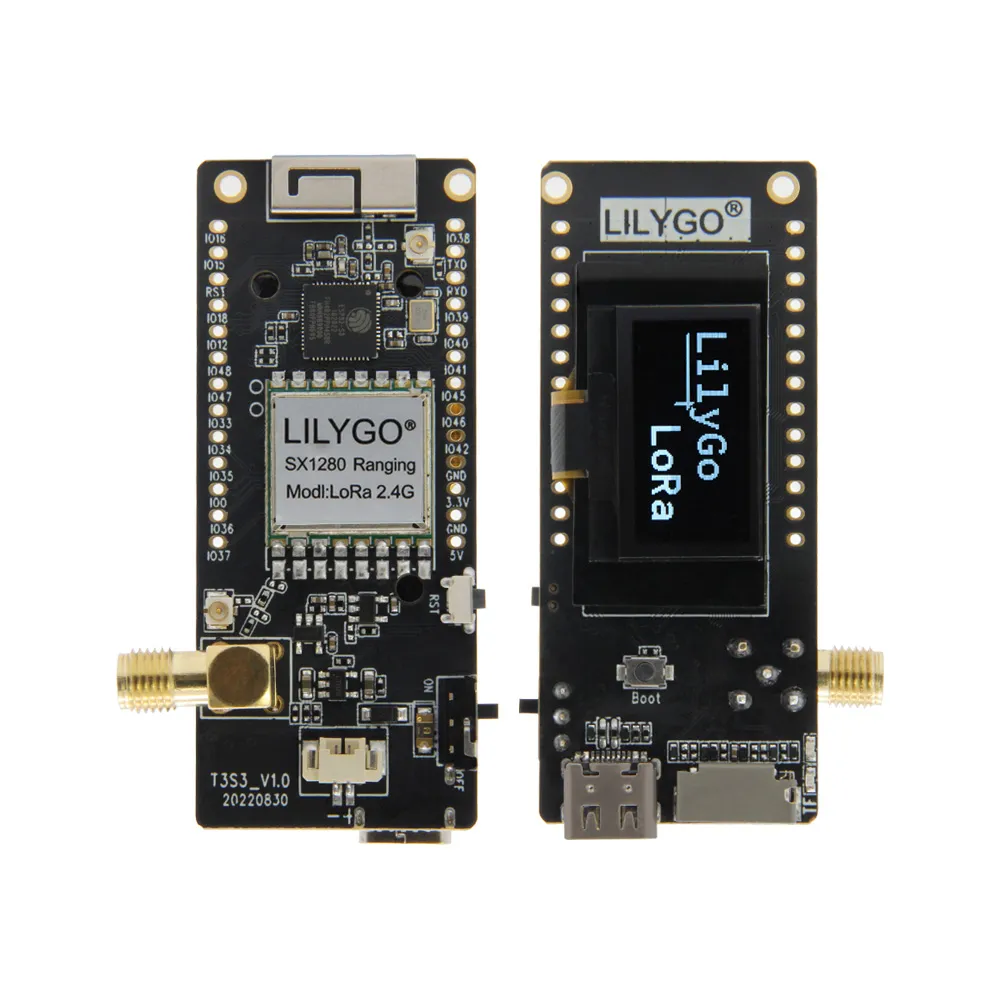
LILYGO® TTGO Lora Devices
Further information on the LILYGO® LoRaLoRaA low-power, long-range wireless communication technology used by Meshtastic devices to enable communication over distances of several kilometers without the need for cellular, Wi-Fi, or other traditional network infrastructures. devices can be found on LILYGO®'s GitHub page.
- Lora T3S3
Lora v3.0
This board is using a first generation Semtech chip and is therefore not recommended for new purchases. Firmware support is phased out. If in doubt, choose the LoraLoRaA low-power, long-range wireless communication technology used by Meshtastic devices to enable communication over distances of several kilometers without the need for cellular, Wi-Fi, or other traditional network infrastructures. T3S3 board.
- MCUMCU (Microcontroller Unit). The microcontroller that runs the firmware on a device. The hardware tables list the MCU for each supported board.
- ESP32ESP32A chipset of microcontroller made/designed by Espressif, used by a number of devices. Higher power usage than nRF52, but often cheaper and supports Wi-Fi if desired. (WiFi & Bluetooth)
- LoRaLoRaA low-power, long-range wireless communication technology used by Meshtastic devices to enable communication over distances of several kilometers without the need for cellular, Wi-Fi, or other traditional network infrastructures. Transceiver
- Semtech SX127x with TCXO for improved frequency stability
- Frequency options
- 433 MHzMHz (Megahertz). A unit of frequency equal to one million hertz (cycles per second), used to specify the operating frequency of LoRa devices in the Meshtastic network, affecting range and data rate.
- 868 MHzMHz (Megahertz). A unit of frequency equal to one million hertz (cycles per second), used to specify the operating frequency of LoRa devices in the Meshtastic network, affecting range and data rate.
- 915 MHzMHz (Megahertz). A unit of frequency equal to one million hertz (cycles per second), used to specify the operating frequency of LoRa devices in the Meshtastic network, affecting range and data rate.
- Connectors
- USBUSB (Universal Serial Bus). The wired connection used to power a device, flash firmware onto it, and communicate with it over serial.-C
- Antenna: IPEXIPEXA miniature coaxial antenna connector found on many boards. The docs write it as U.FL/IPEX, using the two names interchangeably. antenna connector
Features
- Built in 0.96 inch OLEDOLED (Organic Light-Emitting Diode). A display type used on many Meshtastic devices. The OLED Type setting selects which panel driver the firmware uses. or 2.13 inch E-Paper display
- Power and Reset switches, User Button
- microSD connector
- Solar panel and battery connector, includes solar charging circuit (CN3065)
- QWIIC for UARTUART (Universal Asynchronous Receiver-Transmitter). A serial interface used to communicate with a device over its pins or through a USB-to-serial bridge. and I2CI2CA two-wire bus used to attach peripherals such as sensors and displays to a device. each
- No GPSGPS (Global Positioning System). A satellite positioning system. A node with a GPS module determines its own location and can report that position to the mesh.
Lora T3S3 v1.0, v1.1 and v1.2
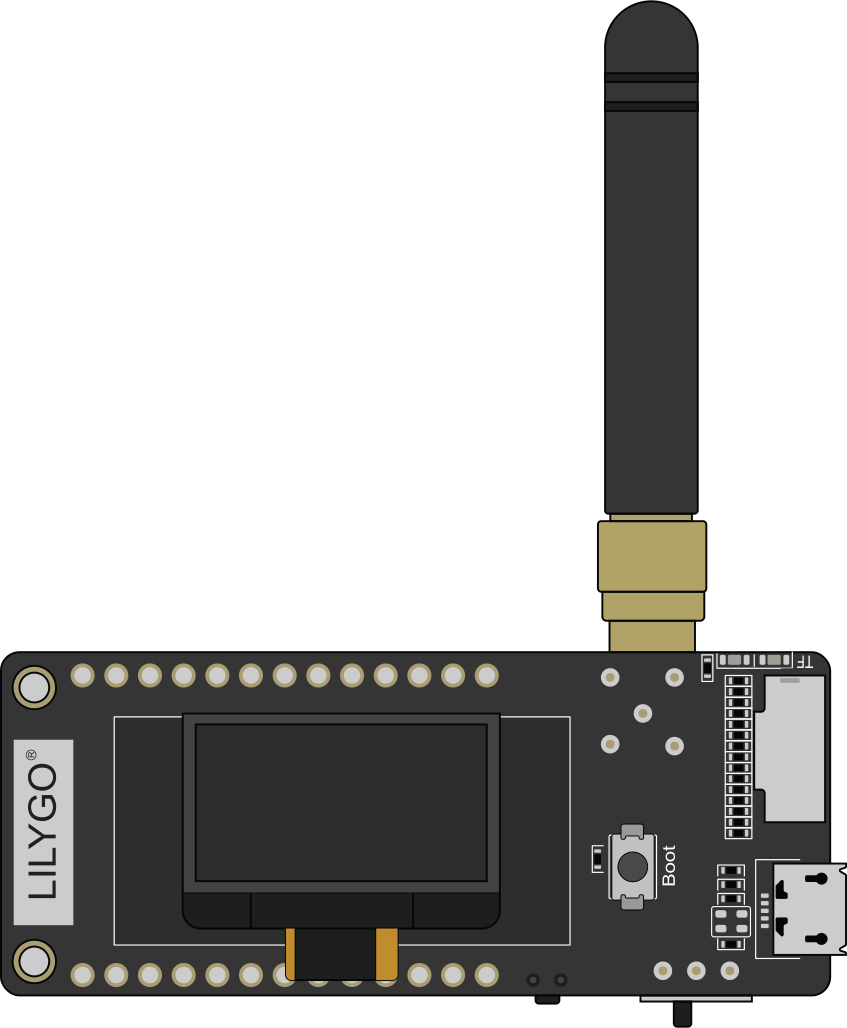
- MCUMCU (Microcontroller Unit). The microcontroller that runs the firmware on a device. The hardware tables list the MCU for each supported board.
- ESP32ESP32A chipset of microcontroller made/designed by Espressif, used by a number of devices. Higher power usage than nRF52, but often cheaper and supports Wi-Fi if desired.-S3 (WiFi & Bluetooth)
- LoRaLoRaA low-power, long-range wireless communication technology used by Meshtastic devices to enable communication over distances of several kilometers without the need for cellular, Wi-Fi, or other traditional network infrastructures. Transceiver
- Semtech SX1262SX1262A Semtech sub-GHz LoRa transceiver, used in most current Meshtastic hardware and recommended over the older SX127x series.
- Semtech SX1276SX1276A first-generation Semtech LoRa transceiver from the SX127x series, no longer recommended for new purchases.
- Semtech LR1121 (Sub-GHz and LORA_24 dual band)
- Semtech SX1280 with PA (Region LORA_24 worldwide use)
- Frequency options
- 868 MHzMHz (Megahertz). A unit of frequency equal to one million hertz (cycles per second), used to specify the operating frequency of LoRa devices in the Meshtastic network, affecting range and data rate.
- 915 MHzMHz (Megahertz). A unit of frequency equal to one million hertz (cycles per second), used to specify the operating frequency of LoRa devices in the Meshtastic network, affecting range and data rate.
- 2.4 GHz
- Connectors
- USBUSB (Universal Serial Bus). The wired connection used to power a device, flash firmware onto it, and communicate with it over serial.-C
- Antenna: SMASMAA threaded coaxial connector for attaching an external antenna. RP-SMA is the reverse-polarity variant, which is not interchangeable with it. antenna connector
Features
- Built in 0.96 inch OLEDOLED (Organic Light-Emitting Diode). A display type used on many Meshtastic devices. The OLED Type setting selects which panel driver the firmware uses. display
- Power and Reset switches, Boot / User Button
- microSD connector
- No GPSGPS (Global Positioning System). A satellite positioning system. A node with a GPS module determines its own location and can report that position to the mesh.
Flashing the T3S3
To flash ESP32ESP32A chipset of microcontroller made/designed by Espressif, used by a number of devices. Higher power usage than nRF52, but often cheaper and supports Wi-Fi if desired.-S3 devices like the T3S3, you typically need to place them in Espressif's firmware download mode. Use the "1200bps reset" button in the web flasher to do this. If this method does not work for any reason, you can follow the manual process below.
Do not proceed unless an antenna is connected to avoid possible damage to the device's radio.
The following process will manually place the device into the Espressif Firmware Download mode:
- Switch off the device.
- Connect the USBUSB (Universal Serial Bus). The wired connection used to power a device, flash firmware onto it, and communicate with it over serial.-C data cable to the device. A blue LEDLED (Light-Emitting Diode). An indicator light on a device. The External Notification module can drive one in response to mesh activity. will illuminate while display stays black.
- Press and hold the BOOT button to the right of the display.
- Switch the device on.
- After 2-3 seconds, release the BOOT button.
With the device now in the Espressif Firmware Download mode, you can proceed with flashing using one of the supported flashing methods. It's generally recommended to use the Web Flasher. You can select "Tlora T3s3 V1" from the device drop-down.
If after successfully flashing the device and the screen remains black, you may need to use the CLI Script to flash Meshtastic.
Resources
- Firmware file:
firmware-tlora-t3s3-v1.xxxxxxx.bin - Purchase Links:
- International