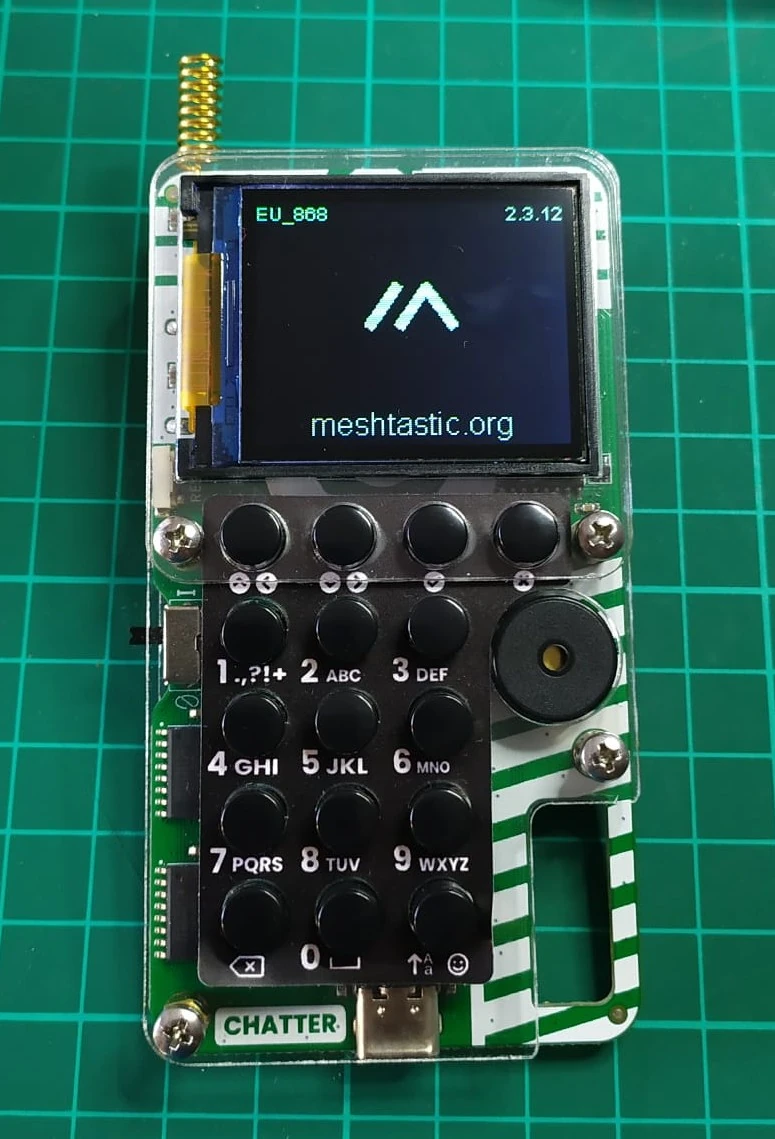
Chatter device
The Chatter is a DIY kit sold by CircuitMess. It is intended as a STEM toy and comes with a nice firmware allowing to connect to other Chatter and exchange messages. However, it's HW is similar to most Meshtastic nodes, with an ESP32ESP32A chipset of microcontroller made/designed by Espressif, used by a number of devices. Higher power usage than nRF52, but often cheaper and supports Wi-Fi if desired., a LoRaLoRaA low-power, long-range wireless communication technology used by Meshtastic devices to enable communication over distances of several kilometers without the need for cellular, Wi-Fi, or other traditional network infrastructures. chip, a screen and few buttons.
There's two versions of the Chatter available with very few actual differences. Chatter V2.0 sports:
- one button (Button 15) wired directly to the ESP32ESP32A chipset of microcontroller made/designed by Espressif, used by a number of devices. Higher power usage than nRF52, but often cheaper and supports Wi-Fi if desired. (pin 36)
- an i2cI2CA two-wire bus used to attach peripherals such as sensors and displays to a device. port to easily connect a GPSGPS (Global Positioning System). A satellite positioning system. A node with a GPS module determines its own location and can report that position to the mesh.
- a different routing
Both versions are fully supported by Meshtastic with the same firmware.
The Meshtastic firmware works with the stock hardware, however, the LLCC68 LoRaLoRaA low-power, long-range wireless communication technology used by Meshtastic devices to enable communication over distances of several kilometers without the need for cellular, Wi-Fi, or other traditional network infrastructures. chip cripples the RFRF (Radio Frequency). The radio signal a node transmits and receives over LoRa. capability of the device. As is, the Chatter can only communicate on the Medium-Slow channel. Switching the chip with the pin-compatible and more capable Heltec RA62 (as mentioned in this GitHub issue https://github.com/meshtastic/firmware/issues/2896) unlock the full potential of the device.
Specifications
- MCUMCU (Microcontroller Unit). The microcontroller that runs the firmware on a device. The hardware tables list the MCU for each supported board.
- ESP32ESP32A chipset of microcontroller made/designed by Espressif, used by a number of devices. Higher power usage than nRF52, but often cheaper and supports Wi-Fi if desired. WROOM (Wi-Fi & Bluetooth)
- Bluetooth 4.2
- ESP32ESP32A chipset of microcontroller made/designed by Espressif, used by a number of devices. Higher power usage than nRF52, but often cheaper and supports Wi-Fi if desired. WROOM (Wi-Fi & Bluetooth)
- LoRaLoRaA low-power, long-range wireless communication technology used by Meshtastic devices to enable communication over distances of several kilometers without the need for cellular, Wi-Fi, or other traditional network infrastructures. Transceiver
- LLCC68
- Frequency options
- EU-868 MHzMHz (Megahertz). A unit of frequency equal to one million hertz (cycles per second), used to specify the operating frequency of LoRa devices in the Meshtastic network, affecting range and data rate.
- Keypad
- 74HC165 based serial keypad
- Connectors
- USBUSB (Universal Serial Bus). The wired connection used to power a device, flash firmware onto it, and communicate with it over serial.-C
Features
- Integrated Keypad for on device message input
- 1.3 inch OLEDOLED (Organic Light-Emitting Diode). A display type used on many Meshtastic devices. The OLED Type setting selects which panel driver the firmware uses. screen
- Optional I2CI2CA two-wire bus used to attach peripherals such as sensors and displays to a device. GPSGPS (Global Positioning System). A satellite positioning system. A node with a GPS module determines its own location and can report that position to the mesh. Module
Resources
- Firmware file:
firmware-chatter2-X.X.X.xxxxxxx.bin - Official build guide