Nano Series
The Nano Series, designed by Neil Hao from B&Q Consulting and powered by Meshtastic, are devices engineered to be a portable and durable solution for outdoor adventures such as hiking, piloting, skiing and more. They are designed to strike a balance between RFRF (Radio Frequency). The radio signal a node transmits and receives over LoRa. performance, size, ruggedness, and power efficiency — providing users with a reliable solution in various outdoor environments.
For a full and complete comparison of the different devices in the Nano series, be sure to visit B&Q Consulting's nano series wiki page.
- Nano G2 Ultra
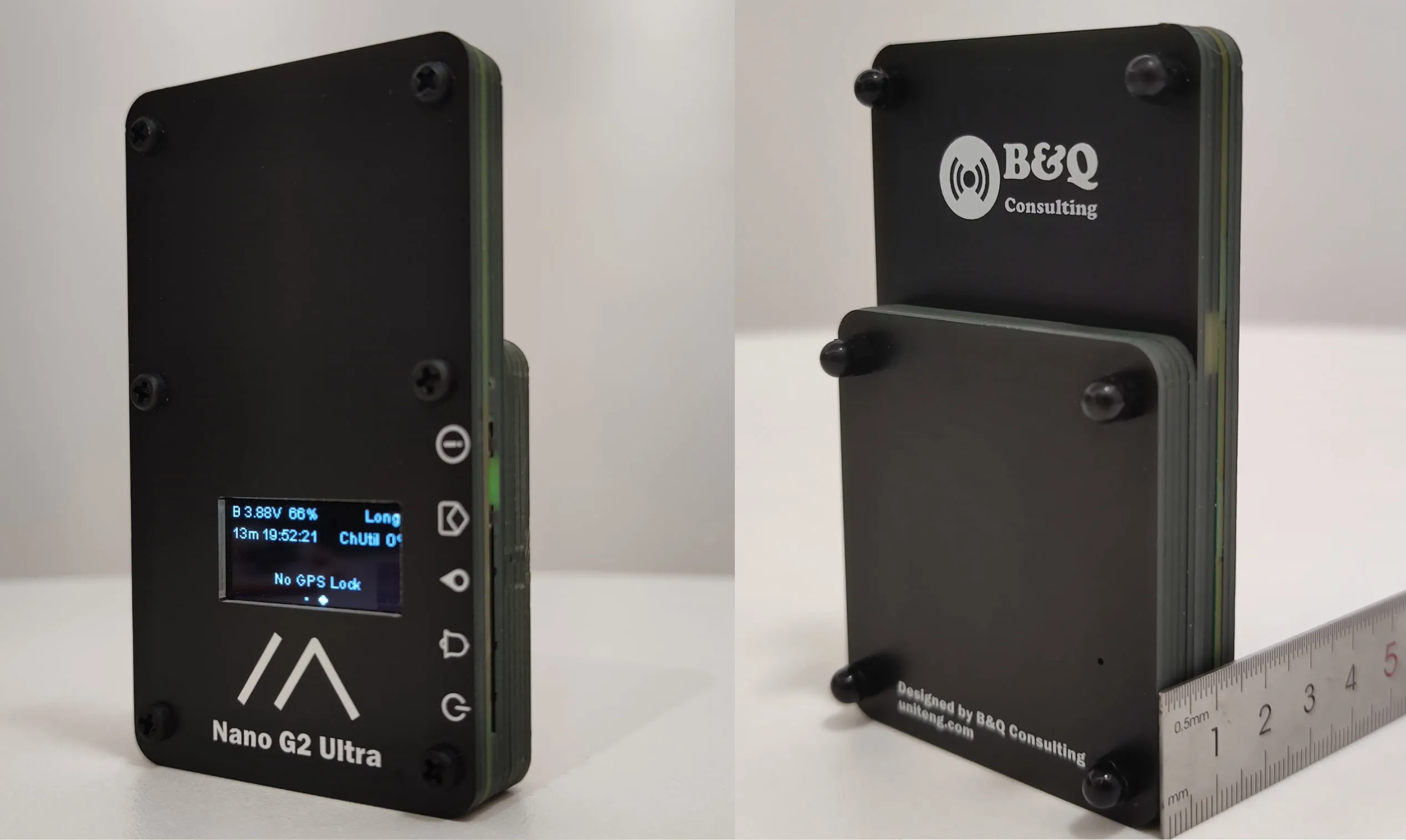
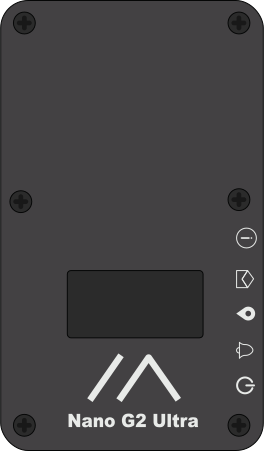
Nano G2 Ultra
The Nano G2 Ultra and Nano G1 Explorer have exactly the same LoRaLoRaA low-power, long-range wireless communication technology used by Meshtastic devices to enable communication over distances of several kilometers without the need for cellular, Wi-Fi, or other traditional network infrastructures. front-end circuit design and internal wideband LoRaLoRaA low-power, long-range wireless communication technology used by Meshtastic devices to enable communication over distances of several kilometers without the need for cellular, Wi-Fi, or other traditional network infrastructures. antenna. The primary design goal of the Nano G2 Ultra is to reduce power consumption and improve battery life by using the low-power MCUMCU (Microcontroller Unit). The microcontroller that runs the firmware on a device. The hardware tables list the MCU for each supported board. nRF52840nRF52840A Nordic microcontroller from the nRF52 family, used in devices such as the RAK WisBlock core modules. Provides Bluetooth LE 5.0 and very low power consumption.. The typical battery life is optimized to be about 3.5 days. As with the Nano G1 Explorer, the Nano G2 Ultra's design also takesTAK (Team Awareness Kit). A situational awareness ecosystem. Meshtastic bridges to it by converting mesh messages to and from Cursor on Target format. into account the potential impact of the human body on its antenna performance, ensuring optimal RFRF (Radio Frequency). The radio signal a node transmits and receives over LoRa. performance even when carried in a pocket.
Specifications
- MCUMCU (Microcontroller Unit). The microcontroller that runs the firmware on a device. The hardware tables list the MCU for each supported board.:
- nRF52840nRF52840A Nordic microcontroller from the nRF52 family, used in devices such as the RAK WisBlock core modules. Provides Bluetooth LE 5.0 and very low power consumption.
- Bluetooth 5.4
- nRF52840nRF52840A Nordic microcontroller from the nRF52 family, used in devices such as the RAK WisBlock core modules. Provides Bluetooth LE 5.0 and very low power consumption.
- LoRaLoRaA low-power, long-range wireless communication technology used by Meshtastic devices to enable communication over distances of several kilometers without the need for cellular, Wi-Fi, or other traditional network infrastructures. Transceiver:
- Semtech SX1262SX1262A Semtech sub-GHz LoRa transceiver, used in most current Meshtastic hardware and recommended over the older SX127x series.
- Frequency Options:
- US (902.0Mhz to 928.0Mhz), EU_868 (869.4Mhz to 869.65Mhz), JP (920.8Mhz to 927.8Mhz), ANZ (915.0Mhz to 928.0Mhz), RU (868.7Mhz to 869.2Mhz), KR (920.0Mhz to 923.0Mhz), TW (920.0Mhz to 925.0Mhz), IN (865.0Mhz to 867.0Mhz), NZ_865 (864.0Mhz to 868.0Mhz), TH (920.0Mhz to 925.0Mhz), MY_919 (919.0Mhz to 924.0Mhz), SG_923 (917.0Mhz to 925.0Mhz).
- Navigation Module:
- ATGM336H-5N-71 (Supports GPSGPS (Global Positioning System). A satellite positioning system. A node with a GPS module determines its own location and can report that position to the mesh., BDS and GLONASS)
- Antenna:
- New internal wide-band antenna with optimized wide-band LoRaLoRaA low-power, long-range wireless communication technology used by Meshtastic devices to enable communication over distances of several kilometers without the need for cellular, Wi-Fi, or other traditional network infrastructures. RFRF (Radio Frequency). The radio signal a node transmits and receives over LoRa. frontend circuit.
- Connectors:
- USBUSB (Universal Serial Bus). The wired connection used to power a device, flash firmware onto it, and communicate with it over serial.-C
Features
- Meshtastic pre-installed.
- New internal GPSGPS (Global Positioning System). A satellite positioning system. A node with a GPS module determines its own location and can report that position to the mesh. antenna that significantly reduces GPSGPS (Global Positioning System). A satellite positioning system. A node with a GPS module determines its own location and can report that position to the mesh. lock time compared to the Nano G1. Additionally, the GPSGPS (Global Positioning System). A satellite positioning system. A node with a GPS module determines its own location and can report that position to the mesh. module can be set to a low-power mode with the GPSGPS (Global Positioning System). A satellite positioning system. A node with a GPS module determines its own location and can report that position to the mesh. physical switch.
- Integrated enhanced message notification circuit for LEDLED (Light-Emitting Diode). An indicator light on a device. The External Notification module can drive one in response to mesh activity. or Buzzer, configurable via physical switches.
- Physical power switch to easily turn the device on/off.
- Replaceable 1.3" OLEDOLED (Organic Light-Emitting Diode). A display type used on many Meshtastic devices. The OLED Type setting selects which panel driver the firmware uses. screen with a FPC connector.
- Internal Li-Polymer Battery Charger. (An optional 3.7V 603450 JSTJSTA small keyed board connector used for battery and solar leads, such as PHR-2 for a LiPo battery and ZHR-2 for solar input. 1.25mm Rechargeable Li-Polymer Battery can also be installed.)
- Buck-boost converter to provide stable 3.3V to the system even when the Li-Polymer battery voltage drops to as low as 2.5V. Supply voltage stability is very important to ensure that the performance of RFRF (Radio Frequency). The radio signal a node transmits and receives over LoRa. circuits meets design expectations.
- NXP PCF8563 Real Time Clock (RTC)
- Optional I2CI2CA two-wire bus used to attach peripherals such as sensors and displays to a device. Extension Board (1x GROVE I2CI2CA two-wire bus used to attach peripherals such as sensors and displays to a device. Socket and 1x SparkFun QWIIC I2CI2CA two-wire bus used to attach peripherals such as sensors and displays to a device. Socket for Sensors and Keyboard)
Resources
- Firmware file:
firmware-nano-g2-ultra-X.X.X.xxxxxxx.uf2 - Unit Engineering's Official Wiki
- Purchase Links:
- International